01 · Research
Find the catalogue entry.
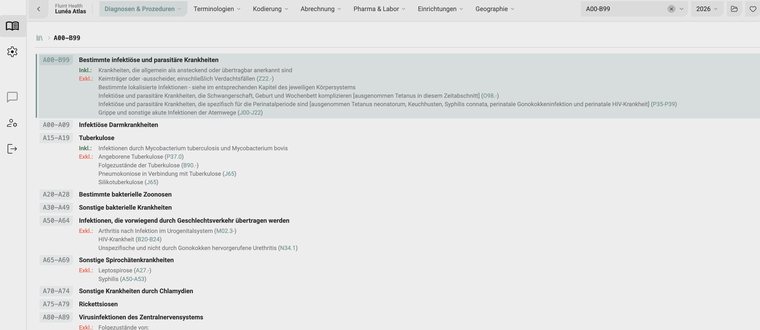
Search ICD-10-GM, OPS or a clinical term. Check inclusions, exclusions and notes in the selected annual edition.
Based on the selected catalogue version.
Explore data sourceslunéa Atlas
The connected reference for inpatient reimbursement. Atlas brings classifications, coding guidelines and reimbursement logic together—with source references, the relevant catalogue editions and an integrated grouper. Independent of your hospital information system (HIS).
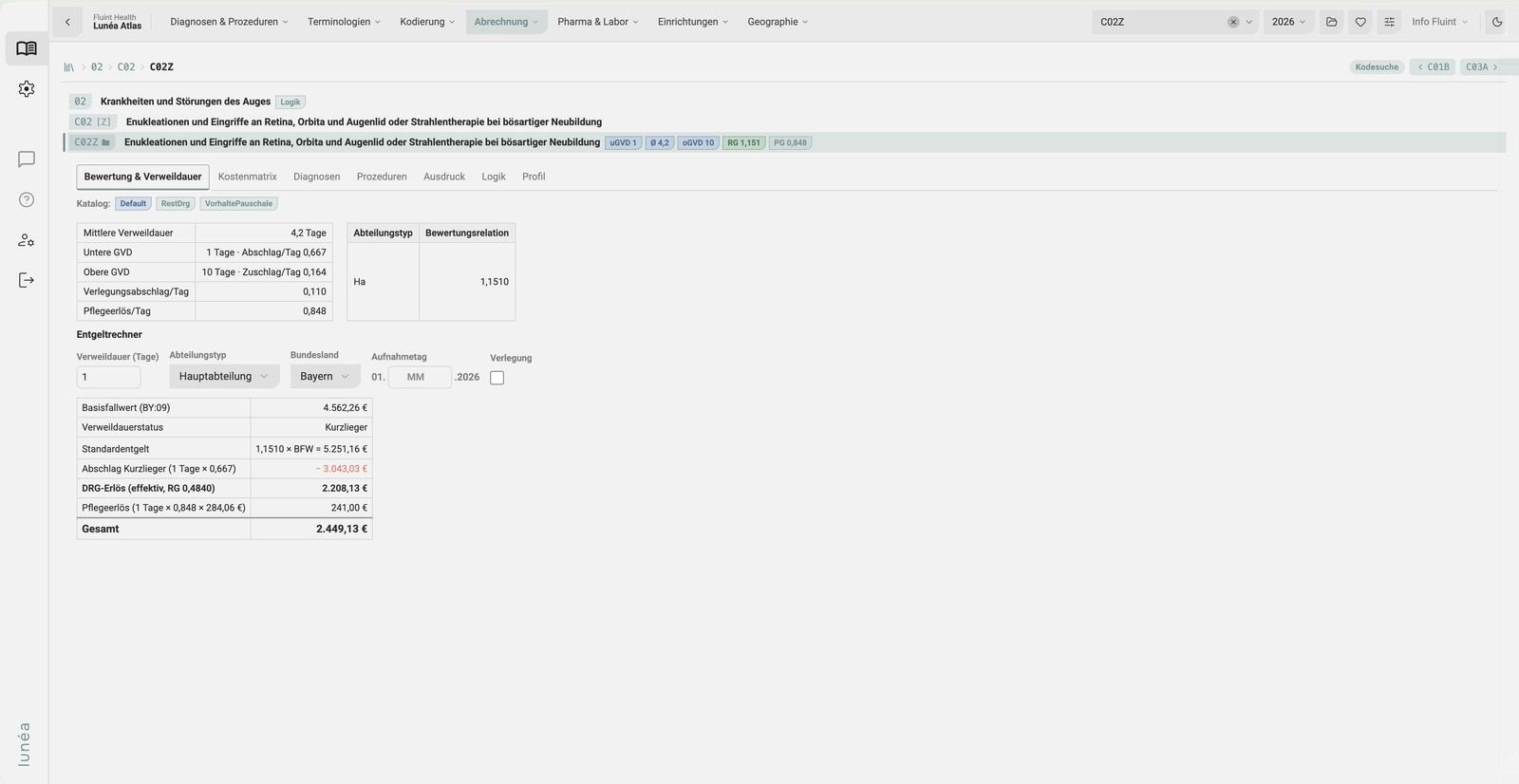
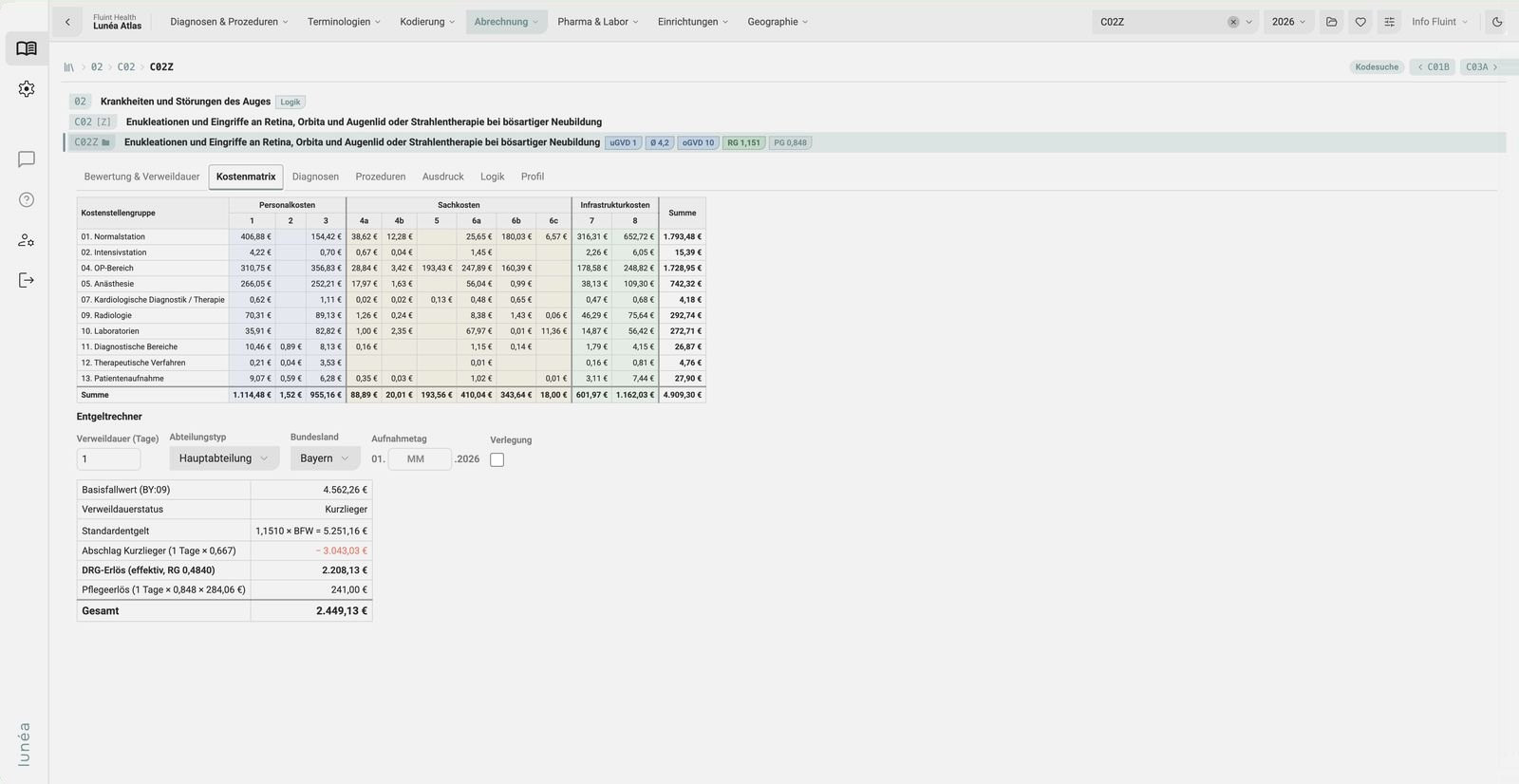
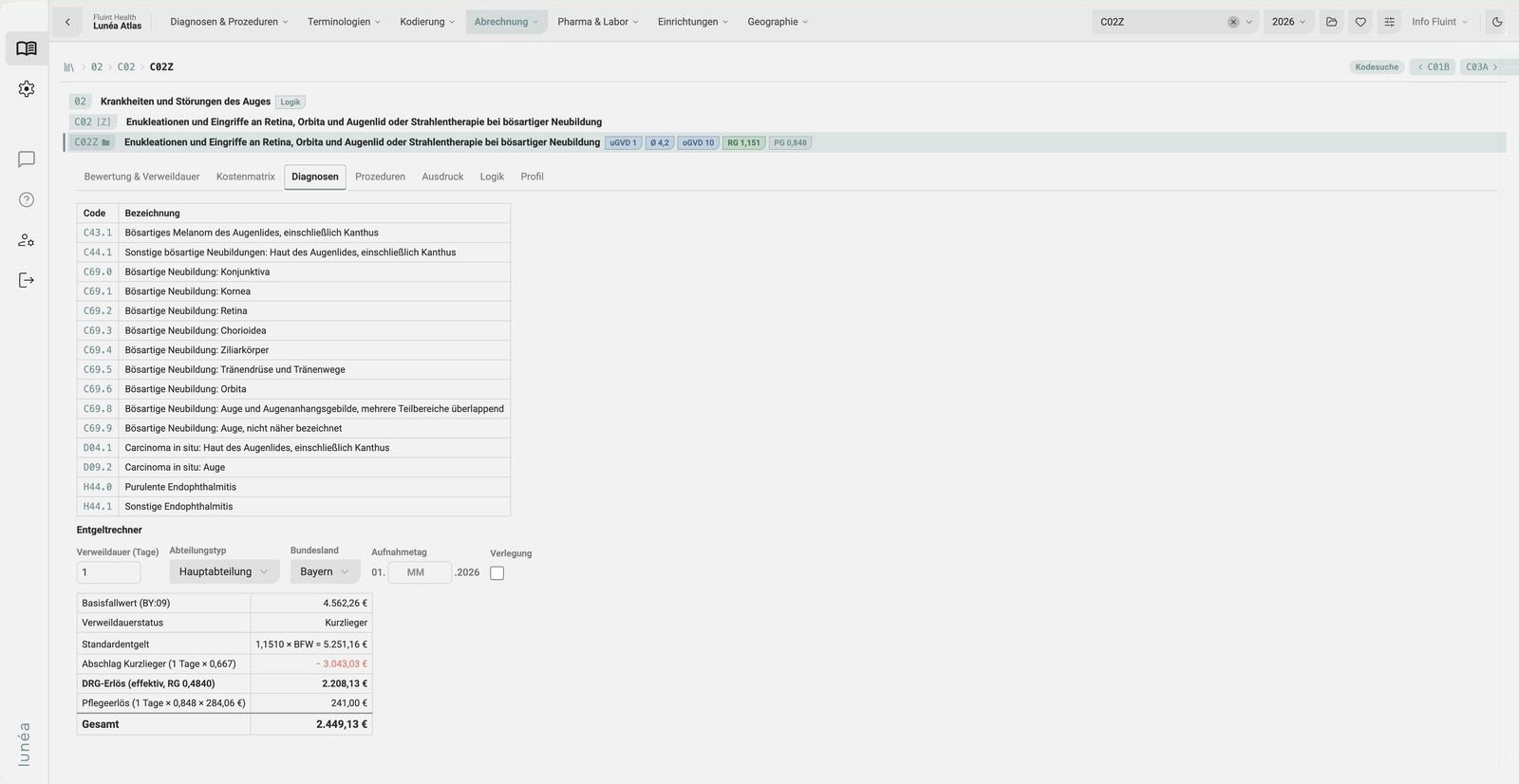
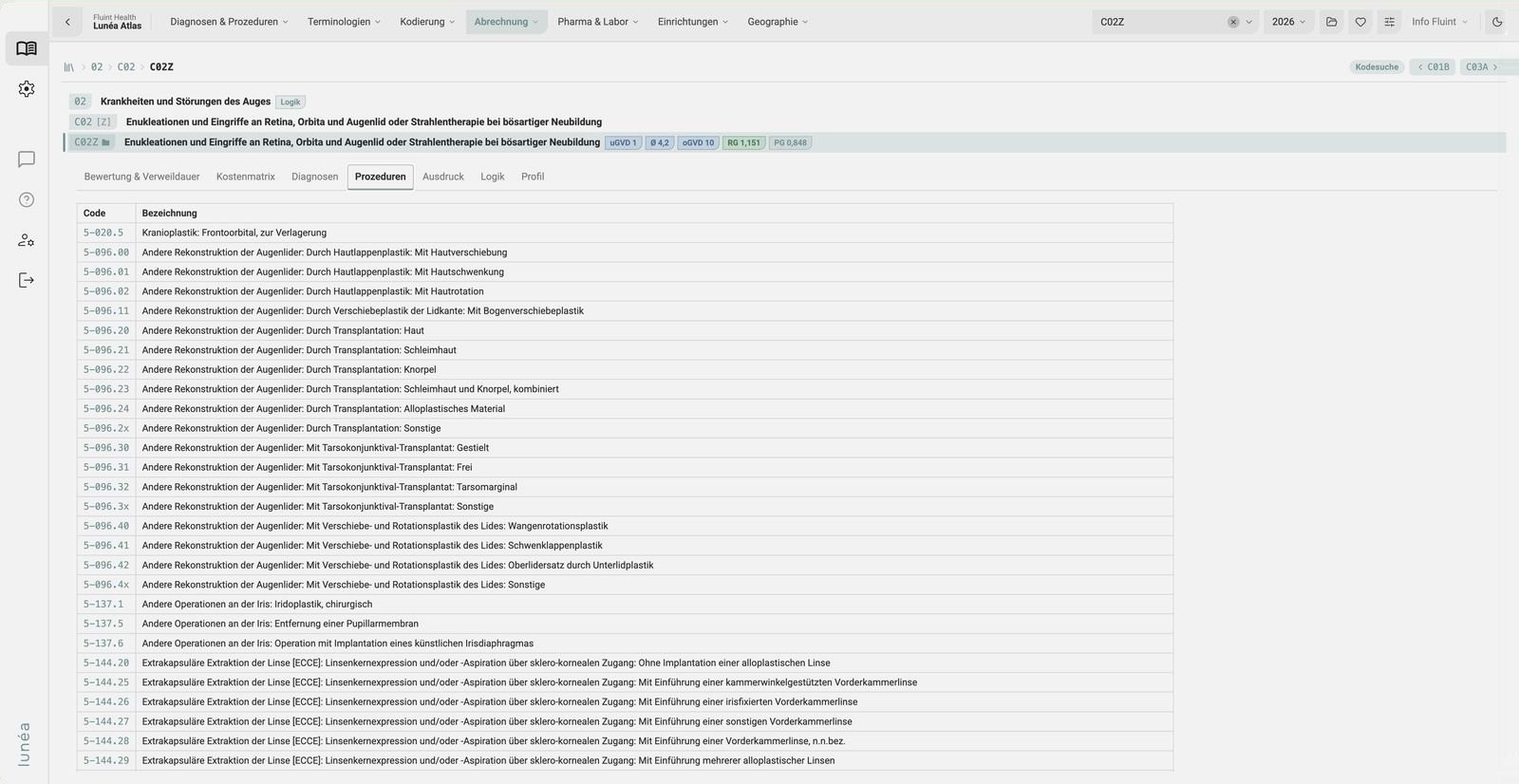
See how the functions work together.
01 · Research
Search ICD-10-GM, OPS or a clinical term. Check inclusions, exclusions and notes in the selected annual edition.
Based on the selected catalogue version.
Explore data sources02 · Context
Open cross-references to coding guidelines and grouping criteria. Read the relevant passage in context.
Based on the source and its associated rules.
Explore cross-references03 · Example case
Enter case characteristics, group the case using the selected grouper version and calculate reimbursement with your chosen parameters.
Based on documented inputs and calculation parameters.
Explore example cases34 sources across seven specialist domains: Atlas connects classifications and rules in a shared data model. Go directly from any entry to the information related to it.
Find the facts, understand the connections and make informed decisions.
ICD-10-GM, OPS, Alpha-ID and ICD-O, including their inclusions, exclusions, thesaurus entries and metadata flags.
The current release of SNOMED CT, Orphanet for rare diseases, and LOINC and UCUM for laboratory tests and units of measurement.
Full-text German Coding Guidelines (DKR and DKR-Psych), plus FoKA coding recommendations with recorded agreement and disagreement—accessible directly from the code.
The aG-DRG catalogue, service group assignment logic and PEPP reimbursement catalogue, supplementary payments and flat-rate supplements, hybrid DRGs and Section 301 reimbursement codes.
ATC classification with defined daily doses and LOINC laboratory codes—all in the same network of cross-references.
The hospital site directory, updated weekly and geocoded, detailed quality reports, and payers with their institutional identifiers (IK numbers).
Postcodes, municipalities and coordinates: calculate distances and view catchment areas on a map.
Depending on the entry, Atlas links diagnoses to synonyms, dagger-and-asterisk counterparts, coding guidelines and other classifications. It also provides links to DRGs, base DRGs, MDCs and service group assignment logic.
Search using clinical terminology, everyday language or code lists pasted from the clipboard. Fault-tolerant search also accounts for typos.
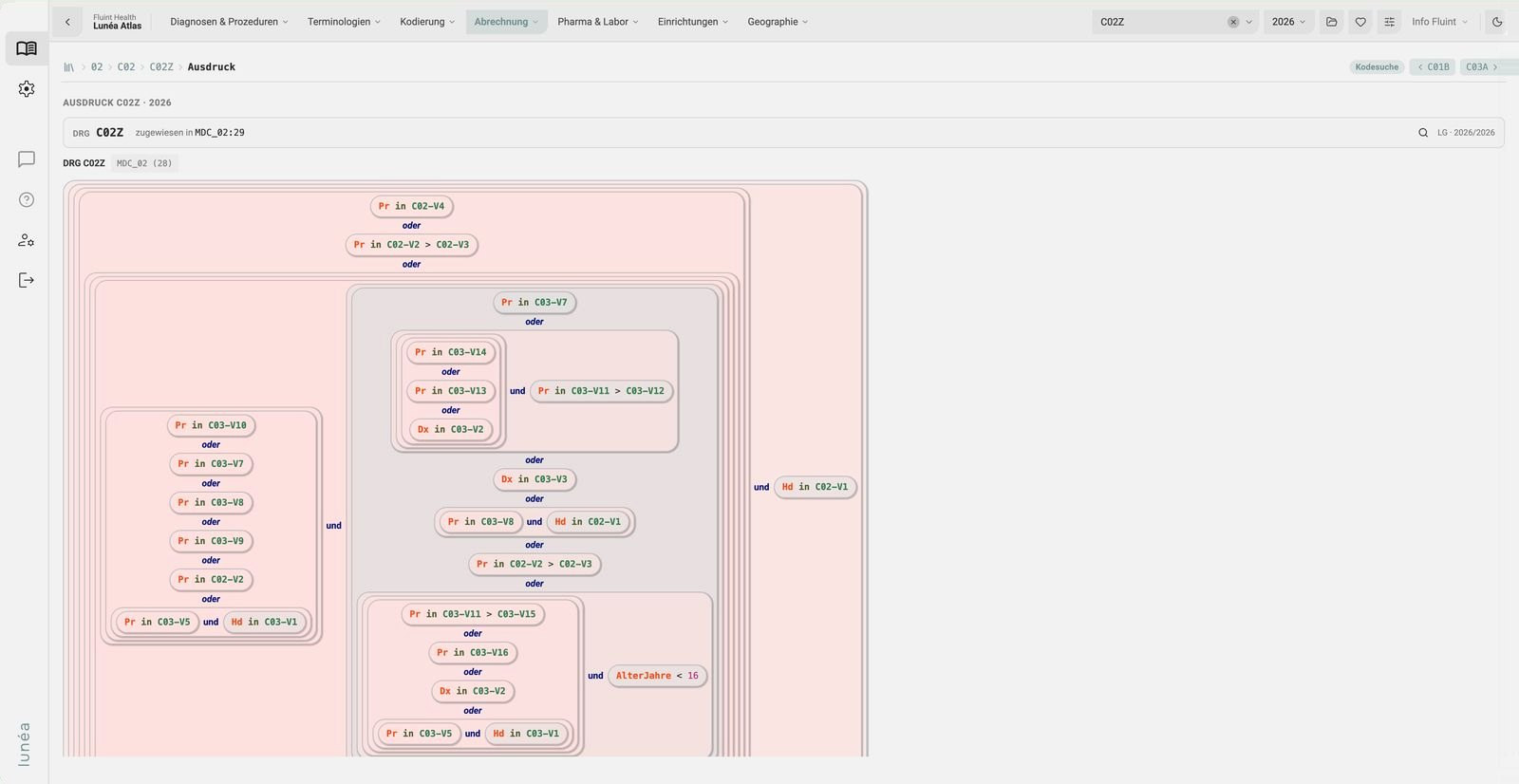
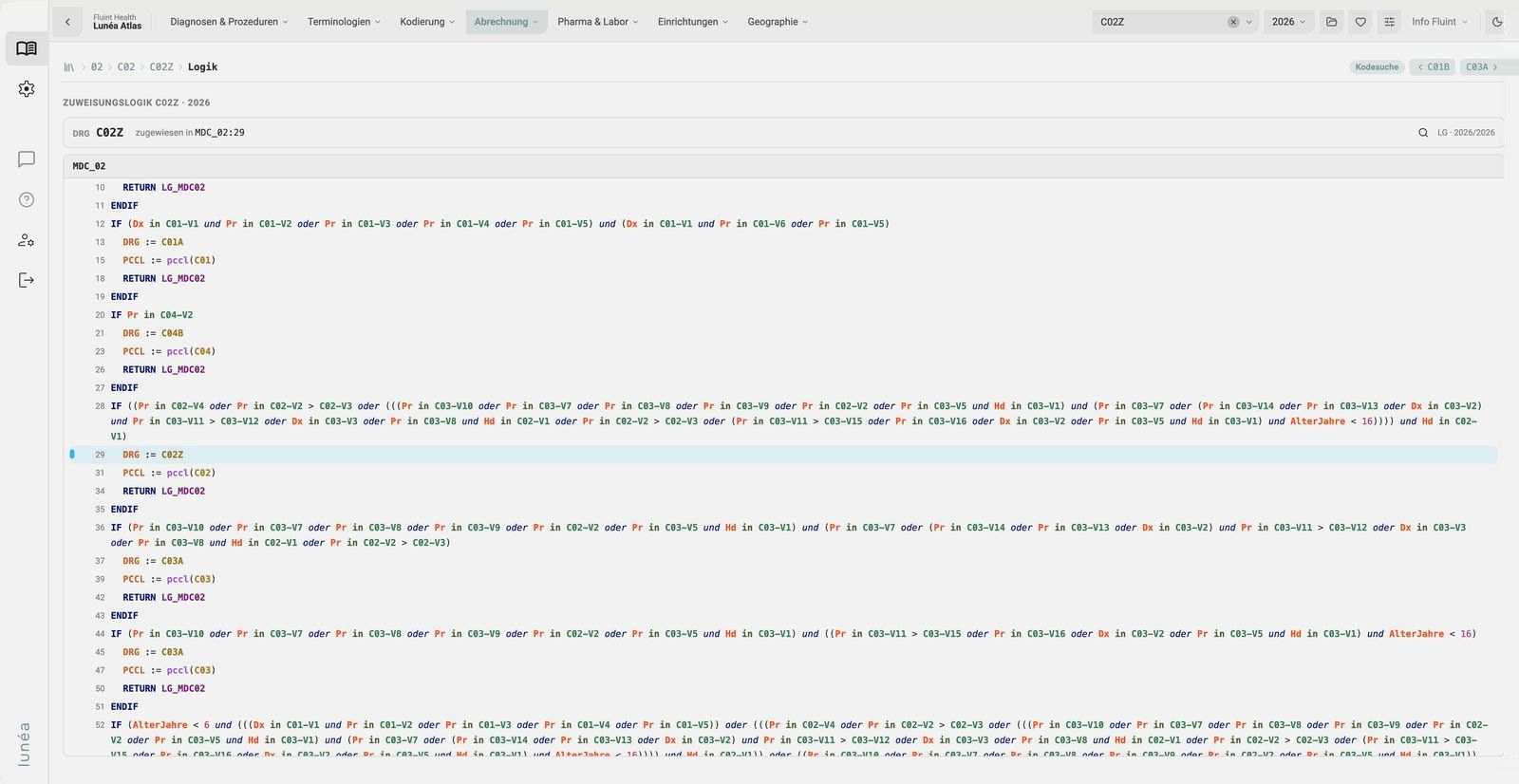
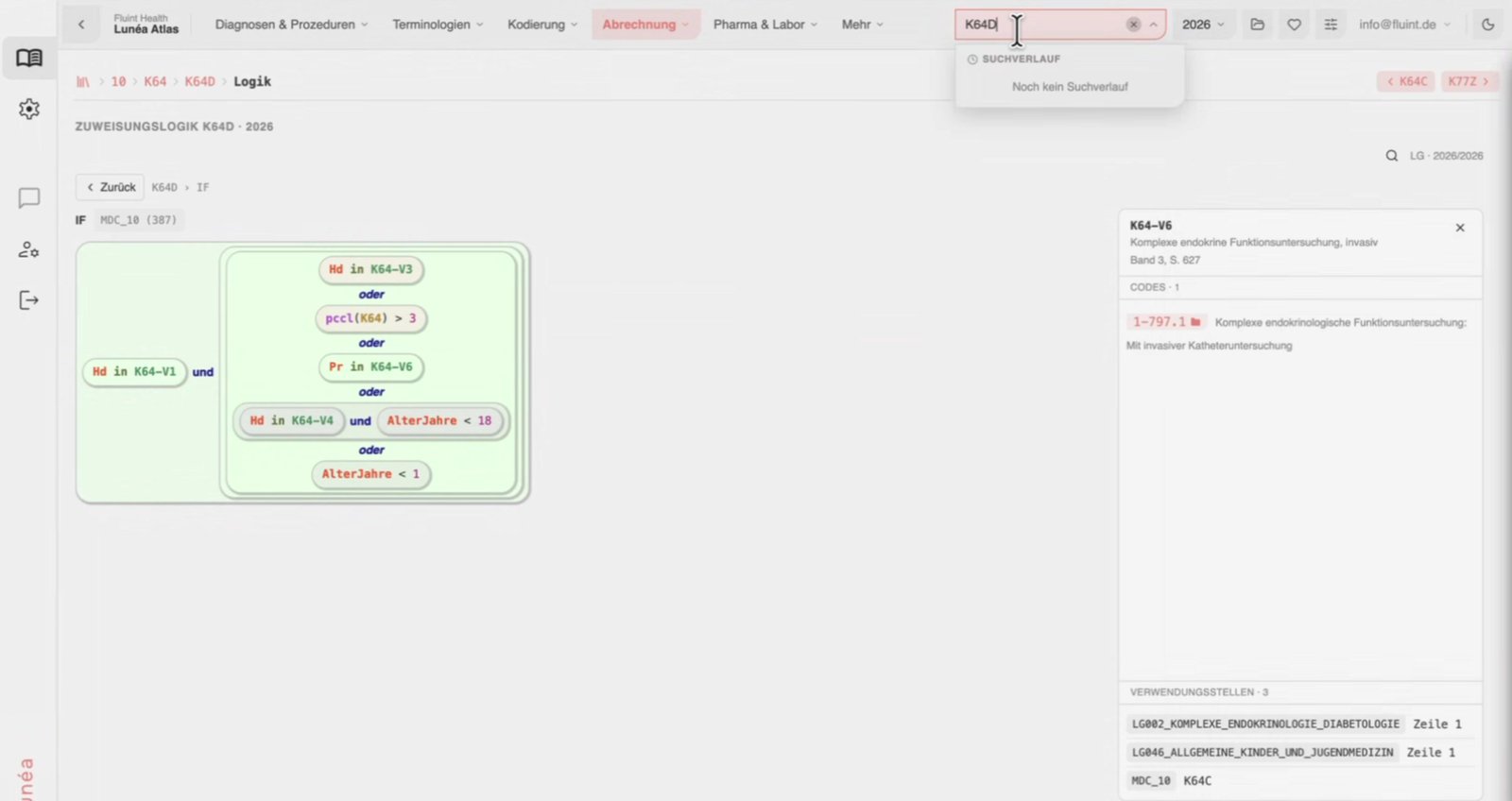
Which conditions determine the DRG assignment? Atlas displays the decision tree with its conditions and tables. The definition logic shows which case characteristics account for different grouping results.
Combine diagnoses, procedures and demographic data in an example case file. The integrated, InEK-certified grouper calculates the assignment from the entered characteristics and selected version. Compare scenarios and understand the outcome through the definition logic.
Export, import and share case files—for training or preparation for a German Medical Service (MD) review. Add bookmarks and notes to any entry. Designed for case scenarios and examples, rather than patient data.
Optional: lunéa Assist answers catalogue and rule questions in a conversation, with a source for each statement. Catalogue search and specialist tools work without AI. If you use AI, you choose the model and where it runs.
Reimbursement calculation follows grouping. Atlas connects the result with the selected calculation parameters and available InEK cost and profile data.
The calculation uses the selected annual catalogue and entered reimbursement parameters, including the state base rate for aG-DRG. Length of stay and other case characteristics are taken into account. Assess the result in the context of these assumptions.
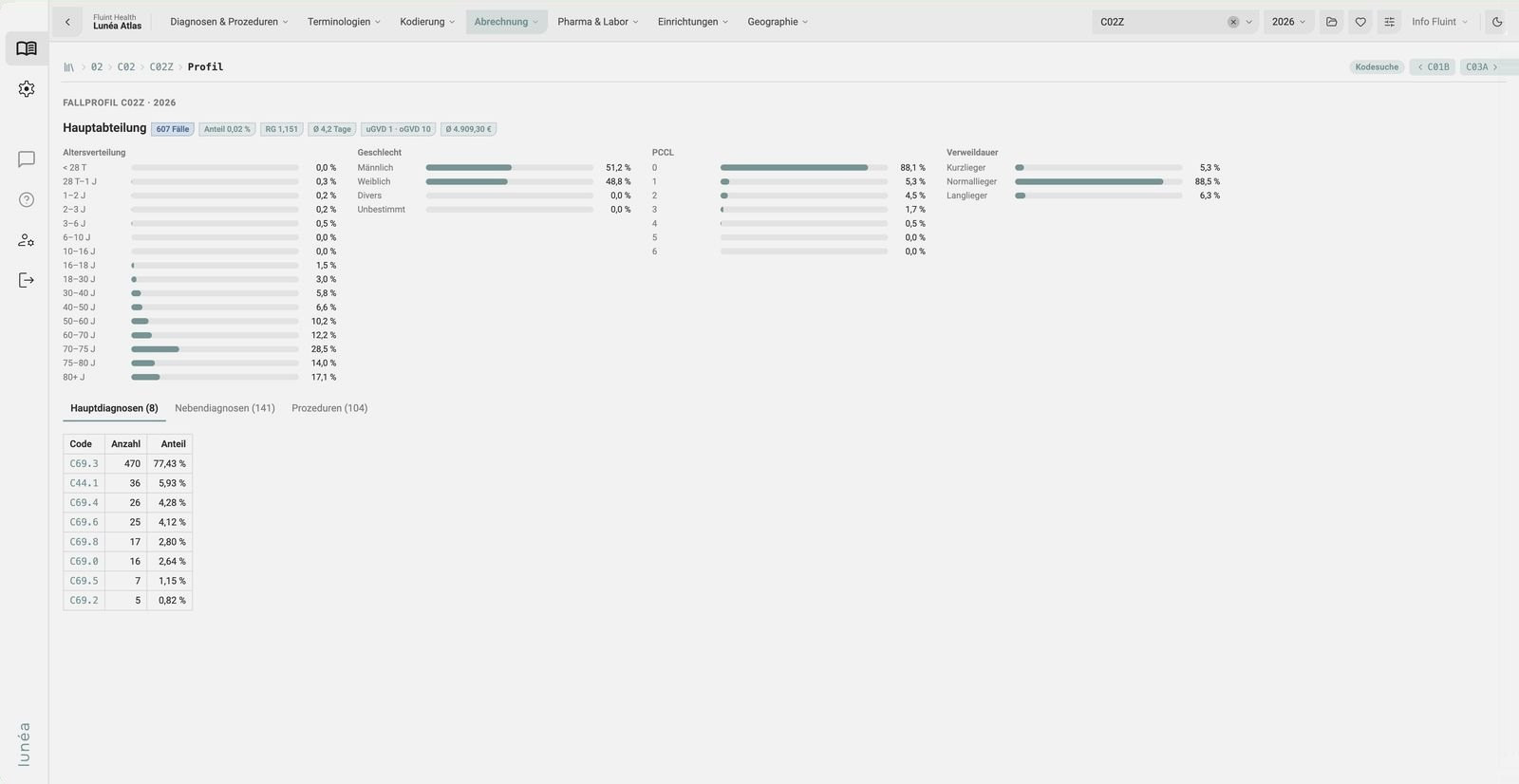
Available InEK cost matrices and profiles enrich the DRG view with age, severity and length-of-stay distributions, as well as common diagnoses and procedures.
Atlas is built for professionals working with DRGs, PEPP and service groups who need a workspace outside the HIS—or deliberately choose an independent one.
Answer coding questions with supporting sources, explore scenarios and prepare for annual changes. For independent professionals and consultancies that need to substantiate results for their clients.
Review cases independently and substantiate your conclusions in a workspace separate from the systems being assessed. Keep the rule, version and source reference in view.
An independent workspace alongside the HIS: check coding, assess revenue effects, and analyse service groups and hospital site data to inform service portfolio decisions.
Current catalogue logic for teaching and training; reimbursement logic, supplementary payments and provider landscape data for market access teams, based on public sources.
The same catalogues, cross-references and certified grouper: in a browser workspace, integrated into your software or available as a tool for agents.
Workspace
Sign in and get started—no installation required. Hosted in Germany, with catalogue updates included and annual editions a click away.
API
Integrate catalogues, cross-references and grouping into your applications through a versioned interface, with annual updates and support.
MCP
Atlas as a tool for virtual assistants: in lunéa, in your own agents and in AI applications that support the Model Context Protocol.
Through the Model Context Protocol, AI assistants can call Atlas catalogues and specialist tools. Answers are based on the retrieved entries and calculation results. Available tools and interactive views depend on the host you use.
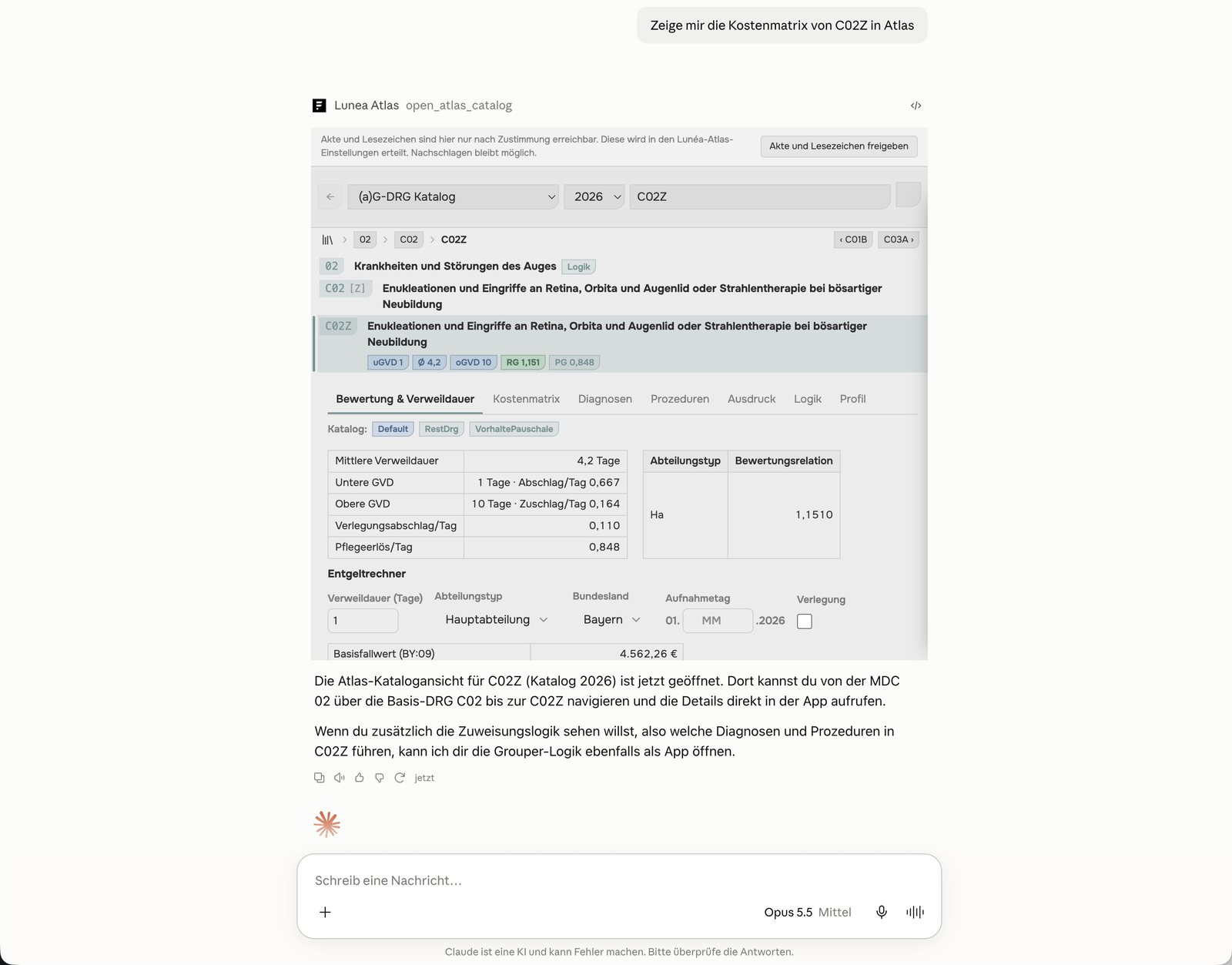
Access is provided through an MCP endpoint and an access key. In hosts that support MCP Apps, the Atlas interface can appear directly in chat—for example, a catalogue view with a DRG cost matrix.
Diagnoses, procedures, coding guidelines, reimbursement catalogues, terminologies and reference data, with official descriptions and hierarchies.
Group the supplied case scenarios using the selected aG-DRG or PEPP version.
Why this DRG? Explore assignment logic, the CCL matrix, grouper tables and tables from the InEK Definitions Manual.
Estimate reimbursement for aG-DRG and PEPP, apply base rates and explore links between codes and DRGs in both directions.
Atlas checks whether codes exist, are terminal codes and are compatible before answering. If a code is rejected, it provides valid coding alternatives.
We demonstrate research, cross-references and an example case with grouping. Bring a specialist question and the catalogue year you need.